


Most conversations about DPDP implementation stop at what the law requires. The harder question starts the day a team tries to make it work. It spans old systems, cloud apps, vendors, and a dozen colleagues who all have a say in personal data.
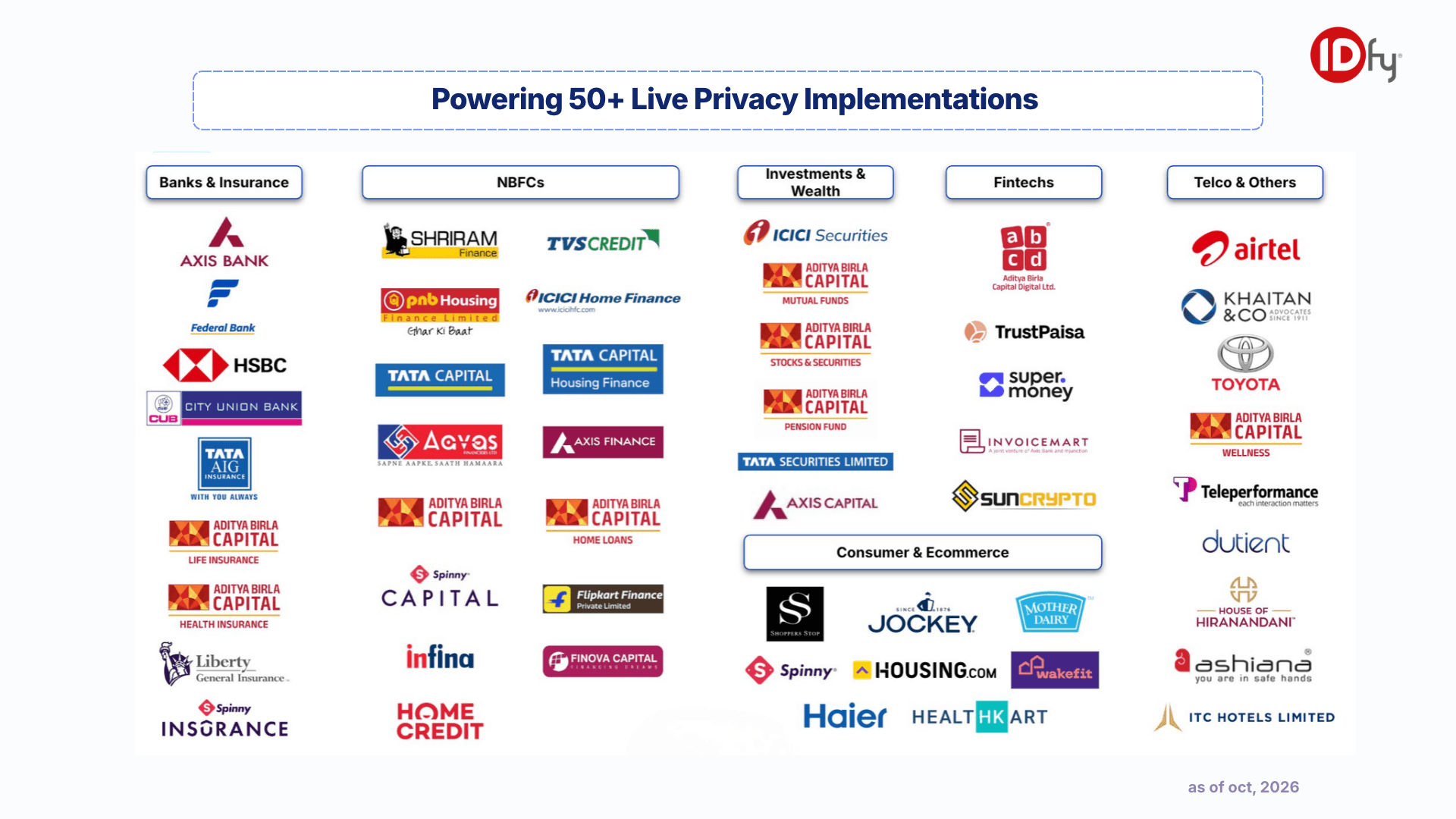
We see that question up close. Across 50+ implementations with Indian enterprises, the same patterns keep surfacing in very different organisations. A scan takes hours, and the access it needs takes days. A notice gets approved after the journey is already set. Everyone agrees on the goal, and nobody owns the decision.
Only a little of it is technology, but most of it comes down to timing, ownership, and sequence.
The scale behind those patterns is hard to picture. At full rollout, our ongoing implementations across 50+ enterprises will discover and govern 10+ PB of personal data. They will protect the privacy rights of 500M+ people and govern 2B+ consent records in real time.
Most of the Risk Lives Inside the House
Privacy asks three things. Where is a person's data? Why do you hold it? Can you act when they ask?
Most DPDP conversations stop at the first page of that story: consent. The real work is governing the data you already hold: where it sits, who can reach it, which vendors touch it, and what it feeds.
"Consent is the front door. Most of the risk lives inside the house."
Ashok Hariharan, Founder and CEO, IDfy
A DPDP Act implementation is the work of getting inside that house.
What Every DPDP Implementation Runs Into
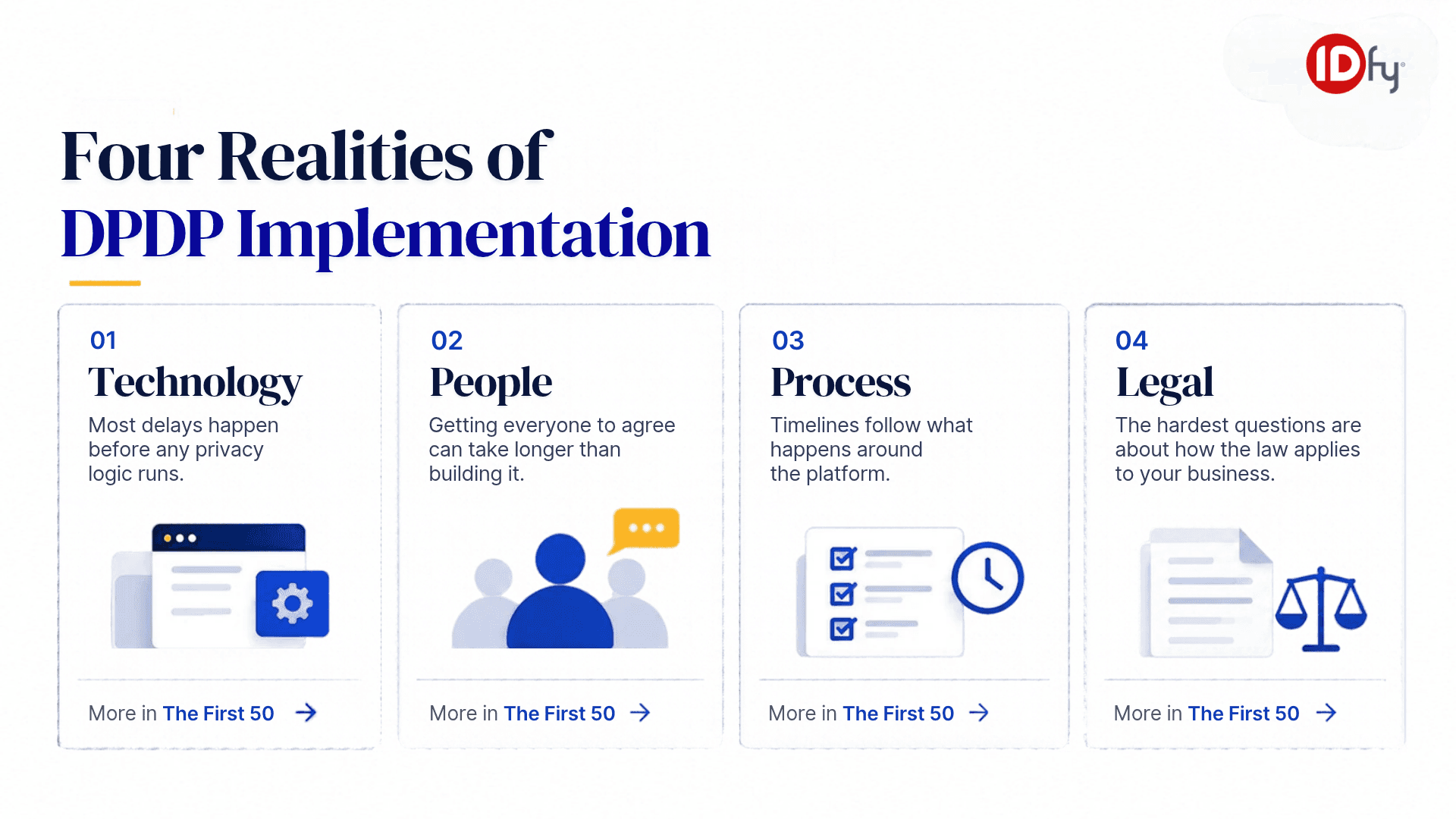
Four realities show up in every programme: technology, people, process and legal. Here is a taste of each, and what the report covers.
Technology. Most delays happen before any privacy logic runs. A scan takes hours, while access, hosting and security reviews take days. Data discovery and data security posture management both depend on an environment that's ready. In the report: why one implementation ends up configuring load balancing by hand, and why deleting data is never as simple as one API call. A third moment covers what grows in your inventory once discovery starts.
People. Getting everyone to agree can take longer than building it. The DPO, technology, legal, business, design, and leadership each have a say, and each one joins at a different moment. In the report: why Design needs a seat well before launch, and why a privacy programme is only as strong as its weakest privacy champion. Five more moves sit behind those two.
Process. A DPDP implementation is more than configuring technology. Timelines follow what happens around the platform: how requirements are understood, who owns decisions, and what "ready" means to each team. A data inventory is where that shared picture starts. In the report: why the strongest implementations begin with the customer's operating model, and how every implementation improves the next. The delivery model we build every implementation is at the end of the chapter.
Legal. The hardest legal questions are rarely about what the law says. They are about how it applies to the way your business works. In the report: the peer trap. A notice that works for a competitor can fail for you, because every data fiduciary has its own purposes, products, and customer journeys. Also, why Legal belongs in the design room long before the approval stage. Two more moments follow.
The Secret Sauce to Get DPDP Implementation Right
Five moves keep shortening a DPDP implementation timeline. With the full obligations applying from 13 May 2027, the order of the work matters as much as the speed. Our DPDP Rules implementation page covers the dates.
- Bring InfoSec in from the start. A late security review reopens decisions you consider settled.
- Build your source and access inventory into the roadmap before you commit to dates. Access approvals set the pace more than the scan does.
- Put Legal and Design in the room while journeys are still being designed. Late reviews leave little room to change the experience.
- Name owners early, and agree who approves what. Approvals often take longer than the build.
- Agree common principles first, then adapt them to each business. Deciding one journey at a time creates rework.
Three phases carry the work from first step to steady state: establish readiness, drive implementation, embed ongoing governance. The report walks through each one.
For the step-by-step version, start with our DPDP implementation guide, and the Right First Time DPDP execution framework covers the thinking behind getting implementation right the first time.
Three Questions to Ask Before You Pick a Platform
The best time to find out whether a platform works for you is before you sign. Our full checklist has ten points. Here are three to start with:
 Give the vendor a real enterprise use case to run, in place of a scripted demo.
- Ask them to show the workflow on your systems, your data sources, and your customer journeys.
- Ask who owns the implementation, and what your internal teams need to provide.
The other seven points cover bringing InfoSec into the evaluation, legacy integrations, enterprise scale and edge cases, configuration versus custom work, implementation experience, vendor stability, and customer references. They sit in the report.
For a longer evaluation list, read what a DPDPA compliance platform needs to have in 2026 and IDfy's seven things an ideal DPDP solution should have.
Not sure where you stand today? Start with Privy's DPDP readiness assessment.
From Enterprise Leaders
"Many important initiatives require balancing structure with practicality. We've appreciated the collaborative nature of discussions with the Privy team and the effort to understand how decisions translate into day-to-day operations."
Nilanjan Ghose, Chief Compliance and Administrative Officer, Khaitan & Co

"At Axis Bank, data privacy and customer trust are our top priorities. Our collaboration with Privy marks a significant step toward strengthening compliance while enhancing customer experience."
N. Balaji, President and Head, Business Intelligence Unit (BIU), Axis Bank
Where Privy Fits
Privy by IDfy puts these lessons to work in every implementation. We implement all 10 modules, or a single module, to fit where your DPDP implementation stands today.
Personal Data Discovery & Governance and Third-Party Risk Management cover the data and processor work. The AI Compliance Co-pilot ties it together, and the full set is on the solutions page.
CLICK HERE TO KNOW MORE ABOUT OUR 50+ JOURNEY - https://www.privybyidfy.com/company/dpdpa-compliance-enterprise-privacy-india
Conclusion
Most DPDP Act implementations stall on timing, ownership, and sequence, and the 13 May 2027 date doesn't move. The enterprises that settle those three early spend their DPDP implementation timeline building. Which of the five moves can you make this week?
To see how Privy by IDfy can support your DPDP implementation, book a demo or write to shivani@idfy.com for a walkthrough.
FAQs
What is DPDP implementation?
DPDP implementation is the work of turning the Act's obligations into working systems and processes. It cuts across technology, people, process and legal, and it has to find, govern, and act on personal data across every system that holds it.
How can enterprises avoid DPDP implementation delays before the 13 May 2027 deadline?
Start now by mapping personal data, securing early buy-in from Legal and InfoSec, assigning clear ownership, and identifying system access and integration dependencies. These steps help prevent delays and rework as the deadline approaches.
What is the DPDP Act implementation deadline?
Consent Manager registration opens on 13 November 2026, and the full obligations apply from 13 May 2027. Penalties go up to ₹250 crore per contravention.
How long does a DPDP implementation timeline run?
It depends on your systems, your teams, and how early you start. The work runs in a fixed order, from discovery through design, build, and integration to vendor fixes, so a late start squeezes every step after it.
What slows a DPDP implementation timeline?
The same patterns keep recurring: the right people join late, ownership is unclear, security reviews start after the design is set, and approvals take longer than the build. Most come down to timing, ownership, and sequence.
Who should be involved in a DPDP implementation?
The DPO, technology, legal and compliance, business, design, and leadership all have a say. Naming owners early and bringing the right people in before their decisions become dependencies shortens the work.